Product category 01
Three-Point Seat Belts
A diagonal shoulder section and a lap section anchored at three points — the standard occupant restraint in modern passenger vehicles, and the category we are asked for most often.
Overview
How this category works
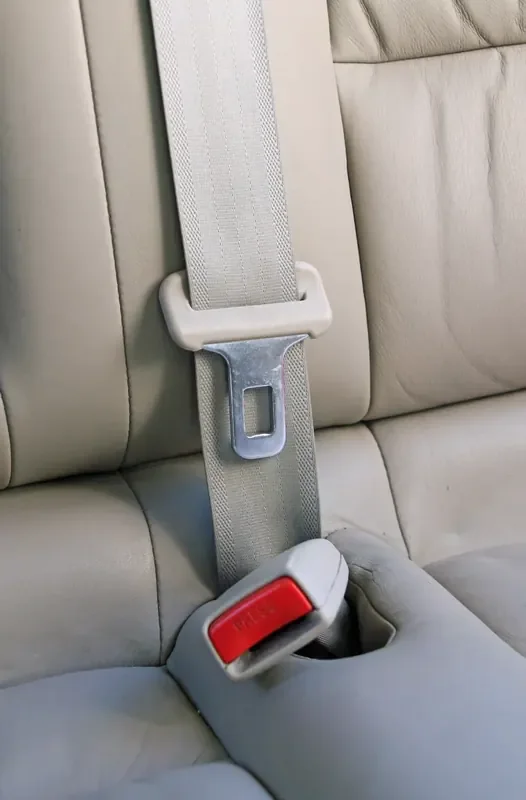
A three-point belt anchors at three separate points on the vehicle: an upper anchorage at or near the B-pillar or seat frame, a lower outboard anchorage, and the buckle receiver on the inboard side. The webbing runs as one continuous length through the latch plate, which means the same strap forms both the diagonal shoulder section and the lap section.
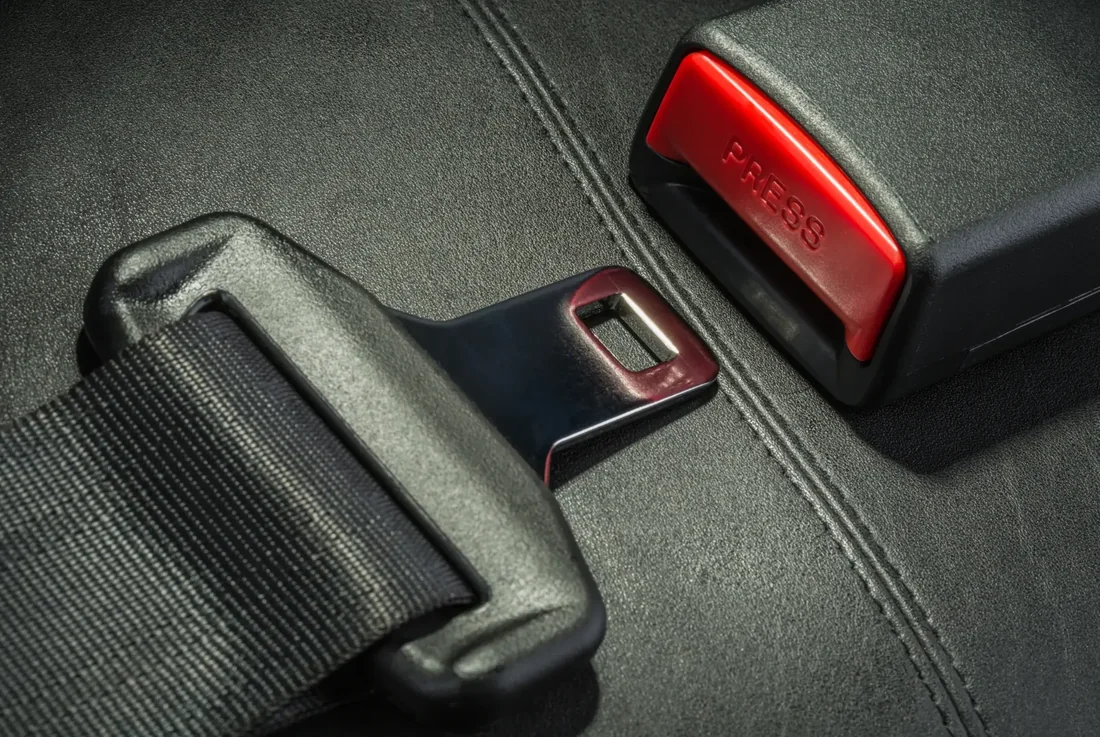
That continuity is the point of the design. Because the webbing passes through the latch plate rather than terminating at it, load is distributed across the chest and the pelvis rather than concentrated in one band. It is also why the latch plate is not an interchangeable accessory: its slot geometry governs how freely the webbing runs through it, and how the two sections balance against each other.
Almost all modern three-point belts are retractable, with the upper section fed from a spool mounted behind the trim or inside the seat frame. Static three-point belts, adjusted manually to the occupant, still turn up in older vehicles and in some specialty seating. The two are not interchangeable without addressing the mounting arrangement, so identifying which one is fitted is the first thing to establish.
Typical applications
Where this category is used
-
Passenger cars and SUVs
The default fitment for driver, front passenger and outboard rear positions. Replacement is usually driven by webbing wear, retractor failure or accident damage rather than by age alone.
-
Vans and light commercial cabs
Cab seating in vans and light goods vehicles is normally three-point, though the mounting arrangement varies considerably between body builders working from the same base chassis.
-
Second and third row outboard seating
Outboard positions in multi-row vehicles use three-point belts, frequently with a different webbing length and retractor mounting than the front row of the same vehicle.
-
Converted and rebodied vehicles
Where seating has been added or relocated, the three-point arrangement has to suit the new anchorage positions. These enquiries need the most detail and should be verified against the installation.

Selection
What decides which one you need
Work through these before ordering. Where you cannot answer one of them, that is exactly the sort of thing to put in an enquiry rather than to estimate.
| Consideration | Why it matters |
|---|---|
| Upper anchorage position and type | Pillar-mounted, seat-integrated or frame-mounted, and whether a height adjuster is fitted. This is the single largest determinant of whether an assembly will fit. |
| Webbing length | Must reach comfortably around the largest expected occupant without leaving excess the retractor cannot manage. Length varies between seat rows in the same vehicle. |
| Latch plate profile | The tongue has to match the receiver exactly — thickness, width and the shape of the locking aperture. Mixing halves between assemblies is unsafe. |
| Retractor mounting and orientation | Spool orientation determines how the webbing feeds. A retractor mounted at the wrong angle will not spool cleanly even where it bolts up. |
| Anchor hardware | Bolt thread, diameter and length, plus any spacers, shoulder bushes or trim pieces the original installation used. |
| Buckle stalk length and side | The inboard receiver has to sit where the occupant can reach it and where it will not foul the seat cushion or console. |
Questions
About three-point seat belts
More questions covering replacement, fitment and bulk supply are answered on the FAQs page.
Not by ordering a three-point belt alone. A third anchorage point has to exist, be correctly located, and be capable of carrying load into the vehicle structure. That is a structural question about the specific vehicle, and it needs a qualified automotive technician to assess it — not a parts decision.
Usually not, even within the same vehicle. Webbing length, retractor mounting, stalk length and anchorage geometry commonly differ between rows. Treat each seat position as its own specification.
Pull the webbing out and let go. If it returns on its own, there is a retractor. If it stays where you left it and has a manual adjuster to take up slack, it is static. Say which one you have when you enquire — it changes the product entirely.
Related categories
Often looked at alongside this
Retractable Seat Belts
Self-retracting assemblies that manage slack automatically, hold the webbing against the occupant in normal driving, and stow it out of the way when unbuckled.
ViewLap (Two-Point) Seat Belts
Two-point belts restraining across the pelvis alone — still specified wherever a shoulder anchorage is unavailable or inappropriate to the seat design.
ViewSeat Belt Buckles & Receivers
The engagement half of the restraint — buckle stalks, receivers and latch plates. Frequently the part that fails while the webbing is still in perfectly good condition.
ViewEnquiries
Tell us the vehicle and the seat position
Send the make, model, year and position, plus photographs of the existing installation. That is normally enough for us to identify what you need or tell you what else to check.
Share the vehicle, the seat position and the belt configuration you are replacing or specifying, and we will come back with the options that fit.